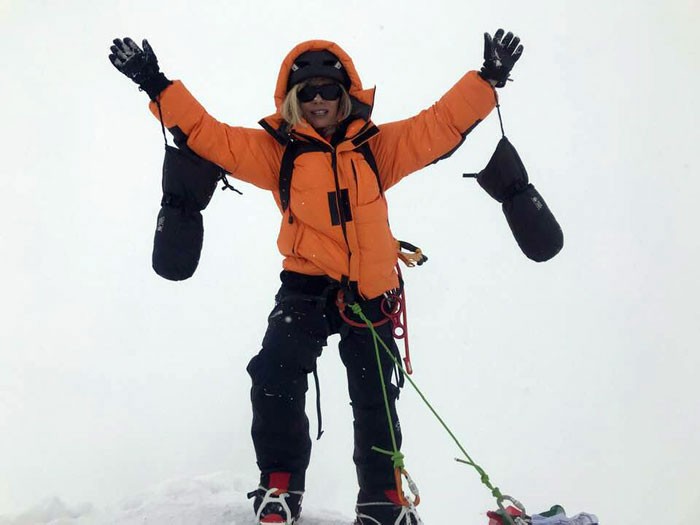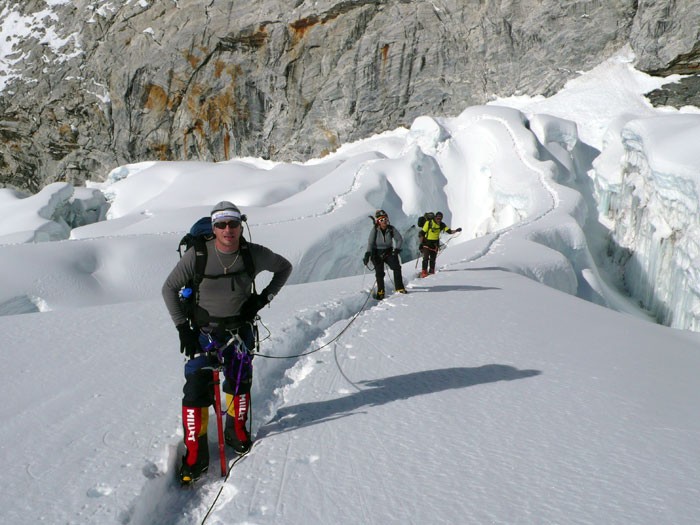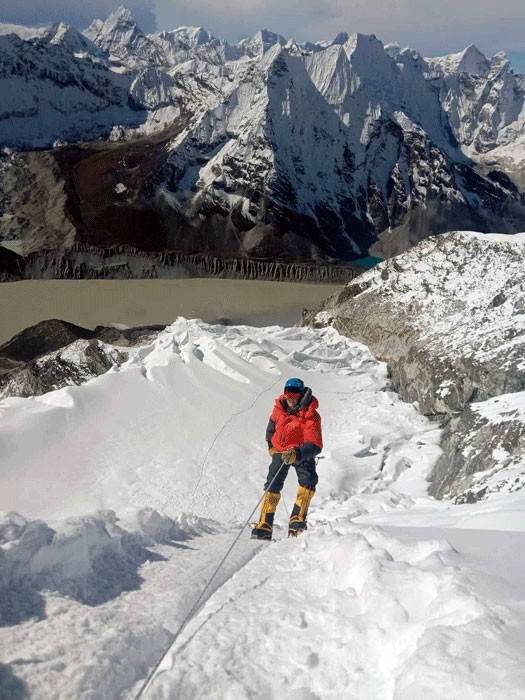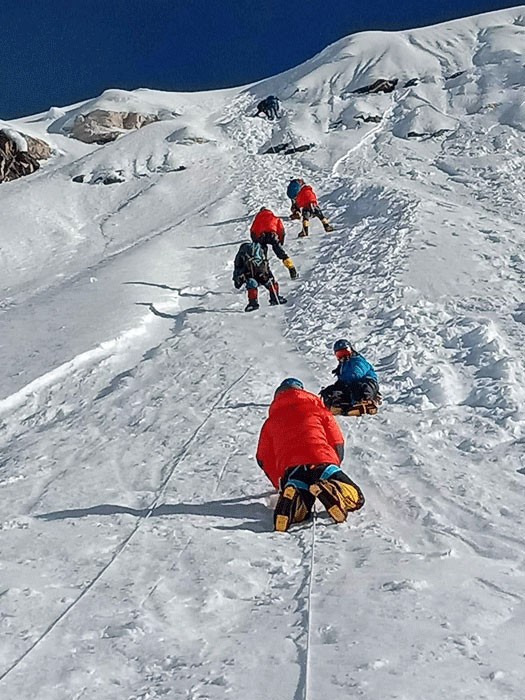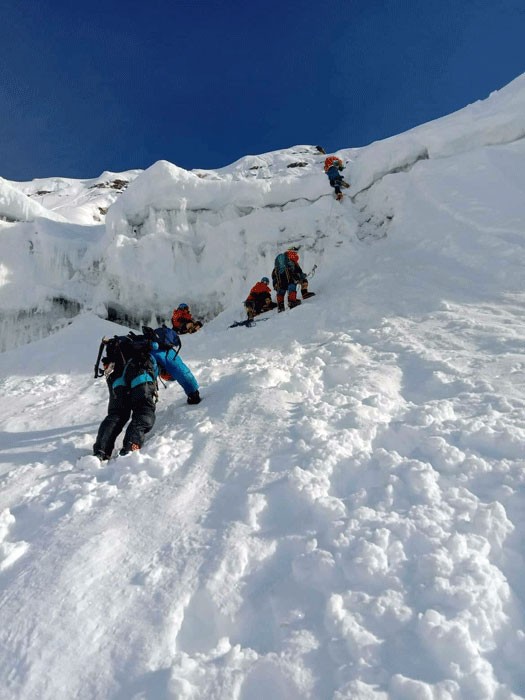

Inexpensive beautiful mountain climb in just 1 day. Perfect for novices. Fun for experienced climbers too.One of the most stunning places to take an up-close look at the high peaks around Everest. Expedition includes a hike to Everest basecamp and Kala Patthar, as well as this fun, "easy" trekking peak.


2026 & 2027 Dates: 7 February to 28 February OR 7 March to 28 March OR 8 April to 29 April OR 21 April to 12 May OR 1 November to 22 November


Full Service Cost: $4,450, £3,350, €3,850. (5 day option): $2,500, £1,850, €2,250. Cost: Island Peak and Ama Dablam Expedition Cost: $8,350, £6,150, €7,250 (fixed in USD)


5 Day Option: We are offering a five day trip for those members that wish to meet our team on day 13 of the itinerary in Chukkung Village and arrange their own trek before and after the 5 days of climbing


Island Peak and Ama Dablam Expedition : 26 October - 22 November 2026 and 2027


We also offer a special Christmas and New Year Island peak expedition on 15 December 2026 to 5 January 2027 : Christmas New Year Trek


Recent News : Click Here to view news of our expedition. Click Here is what people are saying

Island peak - Beginner Climb/Trek Overview

Island Peak (6189m/20,305’) is probably the easiest and most affordable way to obtain high-altitude experience and see how you feel above 6,000 meters. It is also a beautiful place to take an up-close look at the high peaks around Everest, including the famous south face of Lhotse, Makalu and north side of Ama Dablam. Our proposed schedule allows for acclimatization, training, practice and rest. The trip includes a fun trek to Everest Basecamp, as well as a trek to the top of Kala Pattar.


Please watch "Island Peak Video" a very good 7 minute film by Richard Pattison.

Island Peak FAQs
The Island Peak climb can be done at nearly any time of year, but we offer our organized trips to Island Peak three times a year: April, November, and January. April is a very nice time to climb as it is generally dry and sunny with a few occasional weather events, but nothing serious. November is superb, with sunny days and cool clear nights. January is amazing. No one is on the mountain in January and you will have the place to yourself. While April and November are similarly warm, January will be cooler so please dress appropriately for January. 
Please bring $700 cash with you for Island Peak climb.
Permit cost - Spring and Autumn are $250 per person and winter is $125 per person.
Nepalese Visas are offered on arrival at Kathmandu International Airport. It is not necessary to pre-arrange, just show up at the Kathmandu Airport and pay $100
It takes total 22 Days in Nepal to climb Island Peak.
Island Peak is a very basic climb. It is for any person who desires of easy mountaineering adventure.
For Island Peak you need warm trekking clothing (trousers/shirts/underwear/socks), waterproof/windproof outer layers, a very warm thick down jacket with a hood, warm extra layers for your legs, thick warm mitts, medium-weight gloves, warm hats, and sun hats, headlamps with extra batteries, good sunglasses/goggles for snow.
An ice axe, helmet, harness, 2 locking carabiners, 4 standard carabiners, 4 slings, an ascender, a figure 8 descender, a 50-liter rucksack, three one-liter water bottles, a good sleeping bag and you will purchase your sleeping matts in Lukla.
If you brought everything you needed from home, that is fine. However, you can rent everything you need in Kathmandu and many of our Island Peak members rent or buy their clothing, shoes, and equipment in the more than 100 Kathmandu mountaineering and trekking shops, where there is a massive selection of new and second-hand items at good prices.
Island Peak is a renowned trekking peak located in the heart of Nepal. It was discovered in the 1950s by Sherpas and foreign mountaineers who were testing Everest oxygen equipment. This peak stands out on its own, and is not attached to the Nuptse - Lhotse Face through any ridge which is why it was named Island Peak. The popular peak is only a few days' walk away from Namche Bazaar, the trading center for the Khumbu Sherpas. Although Island Peak stands at only 6189m / 20,300 feet high, it is one of Nepal's lowest trekking peaks. This low elevation makes it all the more accessible and thus more popular among travelers looking for shorter climbs close to Mount Everest Base Camp. In fact, Island Peak has become the most sought-after of all of Nepal's trekking peaks because adventurers can easily organize a one-day climb as an add-on to their Everest Base Camp Trek.
You need good mountaineering snow boots with crampons, and good sturdy ankle high leather trekking shoes.
  • Fly to Lukla, trek up to Everest base camp for acclimatization, then on the way back down, side track to Island Peak and finally climb it, head back down to Lukla: 22 days.
  • Fly to Lukla, trek straight up to Island Peak and climb it, then trek straight back to Lukla, without visiting Everest Base Camp: 17 days.
  • Climb Island Peak as an “optional add-on” to another trek or climb, such as Ama Dablam, or Lobuche Peak: 5 days
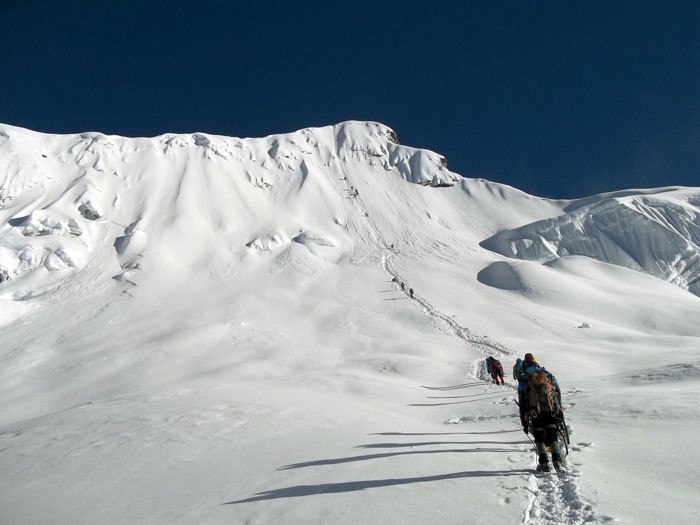
Island Peak is a renowned trekking peak located in the heart of Nepal. It was discovered in the 1950s by Sherpas and foreign mountaineers who were testing Everest oxygen equipment. This peak stands out on its own and is not attached to the Nuptse-Lhotse Face through any ridge which is why it was named Island Peak. The popular peak is only a few days' walk away from Namche Bazaar, the trading center for the Khumbu Sherpas. Although Island Peak stands at only 6189m / 20,300 feet high - making it one of Nepal's lowest trekking peaks - this low elevation makes it all the more accessible and thus more popular among travelers looking for shorter climbs close to Mount Everest Base Camp. In fact, Island Peak has become the most sought-after of all of Nepal's trekking peaks because adventurers can easily organize a one-day climb as an add-on to their Everest base camp trek.
Sherpas will carry your heavy pack during the climb, and you just need to carry your light bag.
Your climb leader will be a western guide so you don’t need to learn Nepali language. Friendly sherpas will also be there to help you during the climb.
Four nights at the Harati Hotel are included in your trek fee i.e. two nights at the beginning of your trek and two nights at the end. Most of our guests stay happily at the Harati Hotel, a clean, friendly, hot water hotel with good rooms, a nice lobby, and a delicious breakfast located in the Kathmandu tourist district known as Thamel.
We provide three hot meals per day with lots of hot drinks. We do suggest you bring 1 kilo / 2 pounds of snacks like chocolate, chips, nuts, and you can easily and inexpensively buy these in Kathmandu.

Island Peak Expedition Cost

Our full-service climb includes:

5 day option: We offer a five day trip for those members that wish to meet our team on day 13 of the itinerary in Chukkung Village. Members must arrange their own trek before and after the 5 days of climbing. All of the services provided to our full-service members will be offered to members who wish to only do the 5 day program while climbing Island Peak. This can be a great option for those who are participating in other treks/climbs in the region.

  • Expert climbing Sherpa
  • Three meals each day
  • Group emergency equipment and satellite phone
  • Shared tents.
  • All permit fees and liaison officers
  • Access to fixed ropes
  • Use of group gear and supplies
  • Two nights stay in a clean comfortable conveniently located Kathmandu hotel on arrival and two nights prior to departure in a double room. Private rooms are available for a small additional fee.
  • Airport transfer

What is not included?

  • International flights to/from Kathmandu
  • Mountain climbing rescue and travel insurance
  • Personal climbing equipment and clothing
  • Gratuities for staff
  • Nepalese visa
Island Peak FAQs
The Island Peak climb can be done at nearly any time of year, but we offer our organized trips to Island Peak three times a year: April, November, and January. April is a very nice time to climb as it is generally dry and sunny with a few occasional weather events, but nothing serious. November is superb, with sunny days and cool clear nights. January is amazing. No one is on the mountain in January and you will have the place to yourself. While April and November are similarly warm, January will be cooler so please dress appropriately for January. 
Please bring $700 cash with you for Island Peak climb.
Permit cost - Spring and Autumn are $250 per person and winter is $125 per person.
Nepalese Visas are offered on arrival at Kathmandu International Airport. It is not necessary to pre-arrange, just show up at the Kathmandu Airport and pay $100
It takes total 22 Days in Nepal to climb Island Peak.
Island Peak is a very basic climb. It is for any person who desires of easy mountaineering adventure.
For Island Peak you need warm trekking clothing (trousers/shirts/underwear/socks), waterproof/windproof outer layers, a very warm thick down jacket with a hood, warm extra layers for your legs, thick warm mitts, medium-weight gloves, warm hats, and sun hats, headlamps with extra batteries, good sunglasses/goggles for snow.
An ice axe, helmet, harness, 2 locking carabiners, 4 standard carabiners, 4 slings, an ascender, a figure 8 descender, a 50-liter rucksack, three one-liter water bottles, a good sleeping bag and you will purchase your sleeping matts in Lukla.
If you brought everything you needed from home, that is fine. However, you can rent everything you need in Kathmandu and many of our Island Peak members rent or buy their clothing, shoes, and equipment in the more than 100 Kathmandu mountaineering and trekking shops, where there is a massive selection of new and second-hand items at good prices.
Island Peak is a renowned trekking peak located in the heart of Nepal. It was discovered in the 1950s by Sherpas and foreign mountaineers who were testing Everest oxygen equipment. This peak stands out on its own, and is not attached to the Nuptse - Lhotse Face through any ridge which is why it was named Island Peak. The popular peak is only a few days' walk away from Namche Bazaar, the trading center for the Khumbu Sherpas. Although Island Peak stands at only 6189m / 20,300 feet high, it is one of Nepal's lowest trekking peaks. This low elevation makes it all the more accessible and thus more popular among travelers looking for shorter climbs close to Mount Everest Base Camp. In fact, Island Peak has become the most sought-after of all of Nepal's trekking peaks because adventurers can easily organize a one-day climb as an add-on to their Everest Base Camp Trek.
You need good mountaineering snow boots with crampons, and good sturdy ankle high leather trekking shoes.
  • Fly to Lukla, trek up to Everest base camp for acclimatization, then on the way back down, side track to Island Peak and finally climb it, head back down to Lukla: 22 days.
  • Fly to Lukla, trek straight up to Island Peak and climb it, then trek straight back to Lukla, without visiting Everest Base Camp: 17 days.
  • Climb Island Peak as an “optional add-on” to another trek or climb, such as Ama Dablam, or Lobuche Peak: 5 days
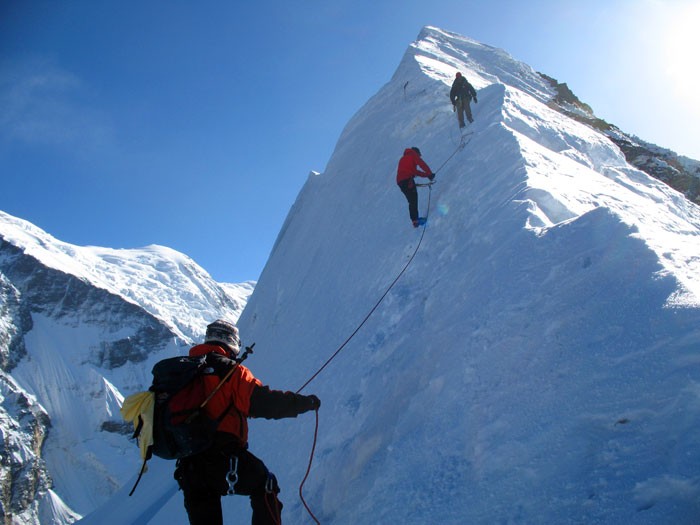
Island Peak is a renowned trekking peak located in the heart of Nepal. It was discovered in the 1950s by Sherpas and foreign mountaineers who were testing Everest oxygen equipment. This peak stands out on its own and is not attached to the Nuptse-Lhotse Face through any ridge which is why it was named Island Peak. The popular peak is only a few days' walk away from Namche Bazaar, the trading center for the Khumbu Sherpas. Although Island Peak stands at only 6189m / 20,300 feet high - making it one of Nepal's lowest trekking peaks - this low elevation makes it all the more accessible and thus more popular among travelers looking for shorter climbs close to Mount Everest Base Camp. In fact, Island Peak has become the most sought-after of all of Nepal's trekking peaks because adventurers can easily organize a one-day climb as an add-on to their Everest base camp trek.
Sherpas will carry your heavy pack during the climb, and you just need to carry your light bag.
Your climb leader will be a western guide so you don’t need to learn Nepali language. Friendly sherpas will also be there to help you during the climb.
Four nights at the Harati Hotel are included in your trek fee i.e. two nights at the beginning of your trek and two nights at the end. Most of our guests stay happily at the Harati Hotel, a clean, friendly, hot water hotel with good rooms, a nice lobby, and a delicious breakfast located in the Kathmandu tourist district known as Thamel.
We provide three hot meals per day with lots of hot drinks. We do suggest you bring 1 kilo / 2 pounds of snacks like chocolate, chips, nuts, and you can easily and inexpensively buy these in Kathmandu.

Island Peak Expedition Itinerary

  1. 1) Arrive in Kathmandu. Stay at hotel.    
  2. 2) Orientation meeting and gear check. Stay at hotel
  3. 3) Fly to Lukla 2840m (9318’). Trek to Phakding 2650 meters (8,694’). Stay at teahouse.
  4. 4) Trek to Namche Bazaar 3440 meters (11,286’). Stay at teahouse.
  5. 5) Rest, acclimate, and relax in Namche Bazaar.
  6. 6) Trek to Tengboche, 3900 meters (12,795’). Stay at teahouse.
  7. 7) Trek to the village of Pheriche, 4250 meters (13,944’). Stay at teahouse.
  8. 8) Trek to the village of Dughla at 4620 meters (15,157’). Stay at teahouse.
  9. 9) Trek to the village Lobuche, 4930 meters (16,175’). Stay at teahouse.
  10. 10) Trek to GorakShep, 5160 meters (16,929’). Stay at teahouse.
  11. 11) Trek to Everest basecamp, onthe Khumbu glacier at 5300 meters (17,388’). Stay at teahouse in GorakShep
  12. 12) Trek to Kala Patar, then go to Dingboche, 4530 meters (14,862 feet’). Stay at teahouse.
  13. 13) Trek to Chukkung Village at 4700 meters (15,420’). Stay at teahouse.
  14. 14) Trek to Island Peak basecamp at 5100 meters (16,732’). Camp
  15. 15) Rest in Island Peak basecamp and train to ascend and descend fixed ropes.
  16. 16) Summit Day, camp in basecamp.
  17. 17) Trek to Pangboche. Stay at teahouse.
  18. 18) Trek to Namche Bazaar. Stay at teahouse.
  19. 19) Trek to Lukla. Stay at teahouse.
  20. 20) Return flight to Kathmandu. Stay at hotel.
  21. 21) Extra day of rest and celebration in Kathmandu. Stay at hotel.
  22. 22) Flight Home.

Island Peak and Ama Dablam Expedition Itinerary

  1. 26 Oct - Arrive in Nepal
  2. 27 Oct - Orientation day, equipment checking, gear shopping and sightseeing in Kathmandu. Stay at hotel.
  3. 28 Oct - Fly to Lukla, 2,900 metres (9,514 feet). Easy short walk to Phakding, 2,550 metres (8,366 feet). Beautiful day of light trekking. Sleep in teahouse.
  4. 29 Oct - Walk to Namche Bazaar, 3,440 metres (11,286 feet). Lovely forest trek over suspension bridges. This big village is the capital of the Sherpa people. Sleep in teahouse.
  5. 30 Oct - Rest & Acclimatization in Namche. Teahouse.
  6. 31 Oct - Walk to Pangboche 3,860 metres (12,644 feet). Famous Everest base camp trekking route with many lodges and restaurants and beautiful scenery of Mt. Ama Dablam. Teahouse.
  7. 1 Nov - Trek to Dingboche
  8. 2 Nov - Rest in Dingboche.
  9. 3 Nov - Trek to Chukkung.
  10. 4 Nov - Walk to Island Peak base camp.
  11. 5 Nov - Climb Island Peak, return to Island Peak base camp
  12. 6 Nov - Walk to Pangboche
  13. 7 Nov - Walk to Ama Dablam Base Camp 4,570 metres (14,989 feet). Beautiful Ama Dablam basecamp is on grassy meadows. Camp.
  14. 8 Nov – Sherpa Prayer Ceremony (Puja) in Base Camp. Rest & Acclimatization,
  15. 9 Nov - Equipment check and fixed rope training day on small cliffs near base camp.
  16. 10 Nov - Walk to advanced basecamp, 5,350 metres (17,552 feet). Easy walking on paths. Sleep there.
  17. 11 Nov - Hike to camp 1, 5,700 metres (18,701 feet). A bit of rockhopping in a boulder field, followed by short easy low angle scramble to C1
  18. 12 Nov - Rest in Camp 1.
  19. 13 Nov - Climb to camp 2, 5,900 metres (19,357 feet). Easy climbing to C2 is on good solid granite, using fixed ropes.
  20. 14 Nov - Wake up in the night, eat "breakfast" and attempt the summit: 6,812 metres (22,349 feet). Summit attempt involves easy snow climbing with a bit of simple mixed rock just above C2. Return and sleep in C2.
  21. 15 Nov - Extra day for summit attempt.
  22. 16 Nov - Downclimb and walk down to basecamp.
  23. 17 Nov - Pack up and descend to Pangboche village. Sleep in teahouse.
  24. 18 Nov - Walk down to Namche Bazaar. Teahouse.
  25. 19 Nov - Walk down from Namche to Lukla. Teahouse.
  26. 20 Nov - Fly from Lukla to Kathmandu.
  27. 21 Nov - Extra day in Kathmandu, in case of delay, and for sightseeing, gift shopping, celebration, saying goodbye to new friends. Stay in hotel.
  28. 22 Nov - Fly back to home country.
Island Peak FAQs
The Island Peak climb can be done at nearly any time of year, but we offer our organized trips to Island Peak three times a year: April, November, and January. April is a very nice time to climb as it is generally dry and sunny with a few occasional weather events, but nothing serious. November is superb, with sunny days and cool clear nights. January is amazing. No one is on the mountain in January and you will have the place to yourself. While April and November are similarly warm, January will be cooler so please dress appropriately for January. 
Please bring $700 cash with you for Island Peak climb.
Permit cost - Spring and Autumn are $250 per person and winter is $125 per person.
Nepalese Visas are offered on arrival at Kathmandu International Airport. It is not necessary to pre-arrange, just show up at the Kathmandu Airport and pay $100
It takes total 22 Days in Nepal to climb Island Peak.
Island Peak is a very basic climb. It is for any person who desires of easy mountaineering adventure.
For Island Peak you need warm trekking clothing (trousers/shirts/underwear/socks), waterproof/windproof outer layers, a very warm thick down jacket with a hood, warm extra layers for your legs, thick warm mitts, medium-weight gloves, warm hats, and sun hats, headlamps with extra batteries, good sunglasses/goggles for snow.
An ice axe, helmet, harness, 2 locking carabiners, 4 standard carabiners, 4 slings, an ascender, a figure 8 descender, a 50-liter rucksack, three one-liter water bottles, a good sleeping bag and you will purchase your sleeping matts in Lukla.
If you brought everything you needed from home, that is fine. However, you can rent everything you need in Kathmandu and many of our Island Peak members rent or buy their clothing, shoes, and equipment in the more than 100 Kathmandu mountaineering and trekking shops, where there is a massive selection of new and second-hand items at good prices.
Island Peak is a renowned trekking peak located in the heart of Nepal. It was discovered in the 1950s by Sherpas and foreign mountaineers who were testing Everest oxygen equipment. This peak stands out on its own, and is not attached to the Nuptse - Lhotse Face through any ridge which is why it was named Island Peak. The popular peak is only a few days' walk away from Namche Bazaar, the trading center for the Khumbu Sherpas. Although Island Peak stands at only 6189m / 20,300 feet high, it is one of Nepal's lowest trekking peaks. This low elevation makes it all the more accessible and thus more popular among travelers looking for shorter climbs close to Mount Everest Base Camp. In fact, Island Peak has become the most sought-after of all of Nepal's trekking peaks because adventurers can easily organize a one-day climb as an add-on to their Everest Base Camp Trek.
You need good mountaineering snow boots with crampons, and good sturdy ankle high leather trekking shoes.
  • Fly to Lukla, trek up to Everest base camp for acclimatization, then on the way back down, side track to Island Peak and finally climb it, head back down to Lukla: 22 days.
  • Fly to Lukla, trek straight up to Island Peak and climb it, then trek straight back to Lukla, without visiting Everest Base Camp: 17 days.
  • Climb Island Peak as an “optional add-on” to another trek or climb, such as Ama Dablam, or Lobuche Peak: 5 days
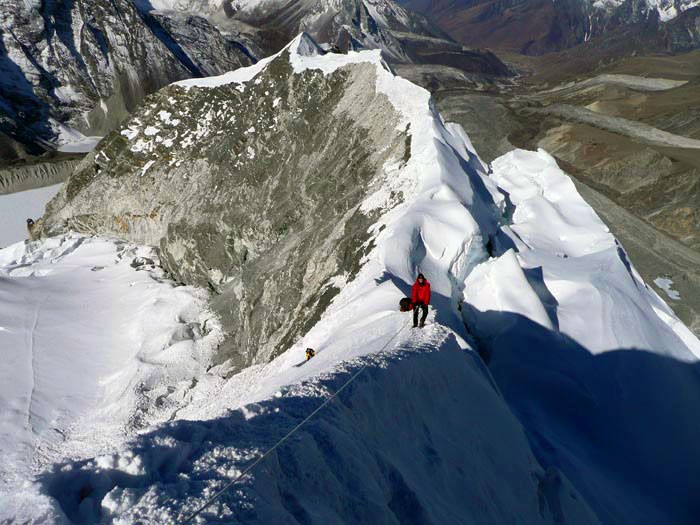
Island Peak is a renowned trekking peak located in the heart of Nepal. It was discovered in the 1950s by Sherpas and foreign mountaineers who were testing Everest oxygen equipment. This peak stands out on its own and is not attached to the Nuptse-Lhotse Face through any ridge which is why it was named Island Peak. The popular peak is only a few days' walk away from Namche Bazaar, the trading center for the Khumbu Sherpas. Although Island Peak stands at only 6189m / 20,300 feet high - making it one of Nepal's lowest trekking peaks - this low elevation makes it all the more accessible and thus more popular among travelers looking for shorter climbs close to Mount Everest Base Camp. In fact, Island Peak has become the most sought-after of all of Nepal's trekking peaks because adventurers can easily organize a one-day climb as an add-on to their Everest base camp trek.
Sherpas will carry your heavy pack during the climb, and you just need to carry your light bag.
Your climb leader will be a western guide so you don’t need to learn Nepali language. Friendly sherpas will also be there to help you during the climb.
Four nights at the Harati Hotel are included in your trek fee i.e. two nights at the beginning of your trek and two nights at the end. Most of our guests stay happily at the Harati Hotel, a clean, friendly, hot water hotel with good rooms, a nice lobby, and a delicious breakfast located in the Kathmandu tourist district known as Thamel.
We provide three hot meals per day with lots of hot drinks. We do suggest you bring 1 kilo / 2 pounds of snacks like chocolate, chips, nuts, and you can easily and inexpensively buy these in Kathmandu.

Island Peak Expedition Leadership and Staff

LeadershipDan Mazur is a relaxed, friendly, well organized, and highly skilled professional with over 20 years of experience leading people to the summits of Everest, K2, Broad Peak, Gasherbrum, Cho Oyu, Lhotse, Manaslu, Shishapangma, Baruntse, and Island Peak

Sherpas: We employ some of Nepal, Tibet, and the Karakorum’s best local mountaineers and Sherpas to assist team members in realizing their summit goals. Our friendly and loyal high altitude climbing staff has supported teams to the summits of more than ten of the highest peaks in the Himalaya.
Island Peak FAQs
The Island Peak climb can be done at nearly any time of year, but we offer our organized trips to Island Peak three times a year: April, November, and January. April is a very nice time to climb as it is generally dry and sunny with a few occasional weather events, but nothing serious. November is superb, with sunny days and cool clear nights. January is amazing. No one is on the mountain in January and you will have the place to yourself. While April and November are similarly warm, January will be cooler so please dress appropriately for January. 
Please bring $700 cash with you for Island Peak climb.
Permit cost - Spring and Autumn are $250 per person and winter is $125 per person.
Nepalese Visas are offered on arrival at Kathmandu International Airport. It is not necessary to pre-arrange, just show up at the Kathmandu Airport and pay $100
It takes total 22 Days in Nepal to climb Island Peak.
Island Peak is a very basic climb. It is for any person who desires of easy mountaineering adventure.
For Island Peak you need warm trekking clothing (trousers/shirts/underwear/socks), waterproof/windproof outer layers, a very warm thick down jacket with a hood, warm extra layers for your legs, thick warm mitts, medium-weight gloves, warm hats, and sun hats, headlamps with extra batteries, good sunglasses/goggles for snow.
An ice axe, helmet, harness, 2 locking carabiners, 4 standard carabiners, 4 slings, an ascender, a figure 8 descender, a 50-liter rucksack, three one-liter water bottles, a good sleeping bag and you will purchase your sleeping matts in Lukla.
If you brought everything you needed from home, that is fine. However, you can rent everything you need in Kathmandu and many of our Island Peak members rent or buy their clothing, shoes, and equipment in the more than 100 Kathmandu mountaineering and trekking shops, where there is a massive selection of new and second-hand items at good prices.
Island Peak is a renowned trekking peak located in the heart of Nepal. It was discovered in the 1950s by Sherpas and foreign mountaineers who were testing Everest oxygen equipment. This peak stands out on its own, and is not attached to the Nuptse - Lhotse Face through any ridge which is why it was named Island Peak. The popular peak is only a few days' walk away from Namche Bazaar, the trading center for the Khumbu Sherpas. Although Island Peak stands at only 6189m / 20,300 feet high, it is one of Nepal's lowest trekking peaks. This low elevation makes it all the more accessible and thus more popular among travelers looking for shorter climbs close to Mount Everest Base Camp. In fact, Island Peak has become the most sought-after of all of Nepal's trekking peaks because adventurers can easily organize a one-day climb as an add-on to their Everest Base Camp Trek.
You need good mountaineering snow boots with crampons, and good sturdy ankle high leather trekking shoes.
  • Fly to Lukla, trek up to Everest base camp for acclimatization, then on the way back down, side track to Island Peak and finally climb it, head back down to Lukla: 22 days.
  • Fly to Lukla, trek straight up to Island Peak and climb it, then trek straight back to Lukla, without visiting Everest Base Camp: 17 days.
  • Climb Island Peak as an “optional add-on” to another trek or climb, such as Ama Dablam, or Lobuche Peak: 5 days
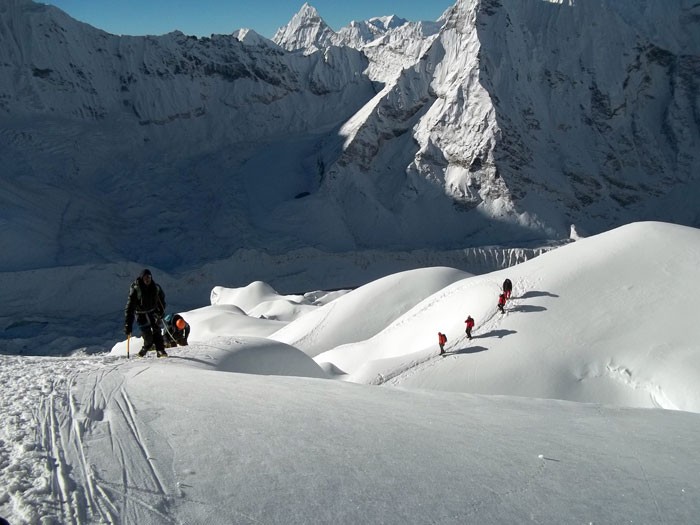
Island Peak is a renowned trekking peak located in the heart of Nepal. It was discovered in the 1950s by Sherpas and foreign mountaineers who were testing Everest oxygen equipment. This peak stands out on its own and is not attached to the Nuptse-Lhotse Face through any ridge which is why it was named Island Peak. The popular peak is only a few days' walk away from Namche Bazaar, the trading center for the Khumbu Sherpas. Although Island Peak stands at only 6189m / 20,300 feet high - making it one of Nepal's lowest trekking peaks - this low elevation makes it all the more accessible and thus more popular among travelers looking for shorter climbs close to Mount Everest Base Camp. In fact, Island Peak has become the most sought-after of all of Nepal's trekking peaks because adventurers can easily organize a one-day climb as an add-on to their Everest base camp trek.
Sherpas will carry your heavy pack during the climb, and you just need to carry your light bag.
Your climb leader will be a western guide so you don’t need to learn Nepali language. Friendly sherpas will also be there to help you during the climb.
Four nights at the Harati Hotel are included in your trek fee i.e. two nights at the beginning of your trek and two nights at the end. Most of our guests stay happily at the Harati Hotel, a clean, friendly, hot water hotel with good rooms, a nice lobby, and a delicious breakfast located in the Kathmandu tourist district known as Thamel.
We provide three hot meals per day with lots of hot drinks. We do suggest you bring 1 kilo / 2 pounds of snacks like chocolate, chips, nuts, and you can easily and inexpensively buy these in Kathmandu.

Island Peak Expedition Personal and Team Equipment

Climbing:

  • Climbing harness
  • 5 meters (16 ft.) of 6mm accessory cord
  • Figure 8 abseil/belay device (tube style devices, i.e. ATC will not work on fixed lines)
  • Full size ascender (i.e. PetzlAscention)
  • 2 locking carabiners, 1 large and 1 small
  • 4 non-locking carabiners
  • Ice axe with leash
  • Steel crampons with anti-balling plates
  • Trekking poles
  • Abseiling/Rappelling Gloves

Upper Body:

  • 2 cotton t-shirts
  • 2 synthetic t-shirts
  • 2 long sleeve synthetic shirts
  • Light-weight soft shell jacket
  • Medium weight insulatingjacket (fleece, down, or synthetic)
  • Hard shell jacket with hood, waterproof and breathable (Gore-Tex or similar)
  • Heavy down coat
     
    • For 6,000m peaks a very warm down coat with hood or an 8,000m coat with hood
    • For 7,000m peaks an 8,000m coat with hood
    • For 8,000m peaks an 8,000m down coat with hood or an 8,000m suit can be used instead

Hands:

  • Lightweight poly-liner gloves
  • Mid-weight soft shell gloves – water/wind resistant
  • Heavy- weight waterproof gloves – Gore-tex shell with removable liner
  • Expedition weight mittens -Gore-tex over mitt matched polar fleece mitt liner

Head:

  • Helmet
  • Warm hat that covers your ears
  • Balaclava
  • Face mask
  • Baseball hat or brimmed sun hat
  • Glacier sunglasses with side shields
  • Ski goggles with light and dark lenses
  • Glasses with clear lenses to protect your eyes while climbing to the summit on windy nights. (cost less than 10 dollars in Kathmandu)
  • Headlamp with extra batteries and bulbs
  • Buff/neck gaiter
  • Bandana or head scarf (optional)

Lower Body:

  • Synthetic underwear
  • Hiking shorts
  • Hiking pants
  • 2 pair lightweight thermal bottoms
  • Medium or expedition weight thermal bottoms
  • Polar fleece or soft shell pants
  • Waterproof/breathable pants with full side zips (Gore-Tex or similar)
  • Heavy insulating pants
     
    • For 6,000m peaks: Down or synthetic pants will full zips
    • For 7,000m peaks: 8,000m down pants
    • For 8,000m peaks: 8,000m down pants or a 8,000m suit can be used instead

Feet:

  • Boots
     
    • For 6,000m peaks: Plastic or composite double boots (Koflach, La SportivaSpantik, etc) Modern waterproof, single boots designed for 4-5,000m peaks may be suitable if they can be worn with 2 pairs of socks and vapor barrier lines and/or they are equipped with overboots
    • For 7,000m: Plastic or composite double boots (Koflach, La SportivaSpantik, etc)
    • For 8,000m peaks: 8,000m boots - One-Sport Millet Everest boots or equivalent
       
  • Sturdy leather walking boots
  • Trainers, running shoes and/or sandals
  • Down booties (optional)
  • 3 pair med-heavy poly or wool socks
  • 2 pair poly or wool liner socks (optional)
  • Vapor barrier liner socks (optional)
  • 2 pair lightweight trekking socks
  • Cotton socks for in town

Sleeping:

  • Down sleeping bag
     
    • For 6,000m peaks: -18C or 0F
    • For 7,000m peaks:-23C or -10F (If you sleep cold consider -29C or -20F)
    • For 8,000m peaks: -29C or -20F (If you sleep cold consider -40C or -40F)
       
  • An additional down sleeping bag for basecamp for the following climbs: Everest, Lhotse, AmaDablam, Manaslu, Cho Oyu, Shishapangma, Broad Peak, K2, Gasherbrum I and II, Spantik, K2/Broad Peak Everest training climb. For Mastagata a second sleeping bag is optional, but highly recommended.
     
    • Down base camp sleeping bag should be rated to -10C or 15F (If you sleep cold consider -18C or 0F)
       
  • 2 closed cell foam kari-mats (sleeping pads) for use in basecamp and high altitude (these can be purchased inexpensively in Kathmandu)
  • High quality inflatable sleeping pad designed for cold weather (Thermarest)
  • Patch kit for inflatable pad

Rucksack and Travel Bags:

  • Medium rucksack/backpack (50-70 litres / 3000-4500 cubic inches, can be used as carry-on bag)
  • Waterproof rucksack cover (optional)
  • 2 large (120+ L / 7500+ cubic inch) duffle kit bags for clothing and equipment
  • Small luggage locks for duffel kit bags

Personal Hygiene:

  • Female or male hygiene supplies
  • 2 tubes lip sun cream
  • Large tube skin sun cream (min factor 30)
  • Anti-mosquito cream
  • Toothpaste/brush
  • Hand sanitizer gel (small-medium bottle)
  • Bar of soap small towel
  • Hand wipes
  • Face Mask
  • Hand sanitiser
  • Disposable gloves
  • Disinfectant wipes

Medical:

  • Small personal first-aid kit. (Simple and Light) Aspirin, first-aid tape, plasters (band-aids), personal medications, etc.
  • Blister repair kit
  • 10 anti-diarrhea pills
  • 20 anti-headache pills
  • 10 cough and/or cold medicine
  • Anti-altitude sickness pills: Diamox, Acetylzolamide
  • 10 Stomach antibiotics: Ciprofloxacin, etc.
  • 5 Azithromycin tables
  • Steri pen or bottle of water purification tablets
  • Cough sweets/lozenges (Halls/Stepils)
  • Earplugs
  • Extra prescription glasses/contact lenses and supplies

Personal Food:

  • Snack food/daily energy food
     
    • Everest training Nepal/Tibet, AmaDablam, Baruntse: 2-4kg (4.5-9lbs)
    • Spantik, Cho Oyu, Shishapangma, Mustagata, Manasu: 2-5kg (4.5-11lbs)
    • Broad Peak, K2, Gasherbrum I/II, K2/Everest training, Everest, Lhotse: 3-6kg (6.5-13lbs)
       
  • Dehydrated meals (freeze-dried dinners) for summit attempt
     
    • Everest training Nepal/Tibet, AmaDablam: 2 meals
    • Spantik, Cho Oyu, Shishapangma, Mustagata, Manasu, Baruntse: 3 meals
    • Broad Peak, K2, Gasherbrum I/II, K2/Everest training, Everest, Lhotse: 5 meals
Practical:
 
  • Small roll of repair tape
  • Sewing repair kit
  • Cigarette lighter
  • Small box matches
  • Compass or GPS
  • Battery powered alarm clock/watch
  • Camera with extra cards and extra batteries
  • Nylon stuff sacks for food and gear storage
  • 2 water bottles (1 litre) wide-mouth Nalgene
  • Pee bottle (1litre or larger)
  • Plastic cup and spoon
  • Small folding knife
  • Binoculars (optional)
  • 4 very large, waterproof, heavy duty disposable rubbish sacks size 150-200 litre = 40-50 gallon. These are necessary for packing. thanks
  • Passport, 2 extra passport photos, flight ticket, flight itinerary
  • Separate photocopies of passport and relevant visa pages, proof of insurance
  • Dollars, pounds, or euros cash
  • Bank/ATM/Cash and credit cards
  • Bathing suit/swim suit (you never know)
  • Paperback books, playing cards, ipod/mp3 player, musical instruments, extra batteries, etc.
  • Travel clothes for basecamp and in town
  • Umbrella (optional)
  • Small solar panels for personal electronics (optional)


Group Equipment:

We provide group gear, equipment, and supplies including: rope, ice, rock, and snow anchor protection, tents; stoves, fuel, walkie-talkie radios, bamboo marker wands, etcetera. A personal tent will be provided for each member at base camp. On the upper mountain, team members will share tents. In base camp, a shower, toilet, solar charger, and a dining tent will be provided

Island Peak FAQs
The Island Peak climb can be done at nearly any time of year, but we offer our organized trips to Island Peak three times a year: April, November, and January. April is a very nice time to climb as it is generally dry and sunny with a few occasional weather events, but nothing serious. November is superb, with sunny days and cool clear nights. January is amazing. No one is on the mountain in January and you will have the place to yourself. While April and November are similarly warm, January will be cooler so please dress appropriately for January. 
Please bring $700 cash with you for Island Peak climb.
Permit cost - Spring and Autumn are $250 per person and winter is $125 per person.
Nepalese Visas are offered on arrival at Kathmandu International Airport. It is not necessary to pre-arrange, just show up at the Kathmandu Airport and pay $100
It takes total 22 Days in Nepal to climb Island Peak.
Island Peak is a very basic climb. It is for any person who desires of easy mountaineering adventure.
For Island Peak you need warm trekking clothing (trousers/shirts/underwear/socks), waterproof/windproof outer layers, a very warm thick down jacket with a hood, warm extra layers for your legs, thick warm mitts, medium-weight gloves, warm hats, and sun hats, headlamps with extra batteries, good sunglasses/goggles for snow.
An ice axe, helmet, harness, 2 locking carabiners, 4 standard carabiners, 4 slings, an ascender, a figure 8 descender, a 50-liter rucksack, three one-liter water bottles, a good sleeping bag and you will purchase your sleeping matts in Lukla.
If you brought everything you needed from home, that is fine. However, you can rent everything you need in Kathmandu and many of our Island Peak members rent or buy their clothing, shoes, and equipment in the more than 100 Kathmandu mountaineering and trekking shops, where there is a massive selection of new and second-hand items at good prices.
Island Peak is a renowned trekking peak located in the heart of Nepal. It was discovered in the 1950s by Sherpas and foreign mountaineers who were testing Everest oxygen equipment. This peak stands out on its own, and is not attached to the Nuptse - Lhotse Face through any ridge which is why it was named Island Peak. The popular peak is only a few days' walk away from Namche Bazaar, the trading center for the Khumbu Sherpas. Although Island Peak stands at only 6189m / 20,300 feet high, it is one of Nepal's lowest trekking peaks. This low elevation makes it all the more accessible and thus more popular among travelers looking for shorter climbs close to Mount Everest Base Camp. In fact, Island Peak has become the most sought-after of all of Nepal's trekking peaks because adventurers can easily organize a one-day climb as an add-on to their Everest Base Camp Trek.
You need good mountaineering snow boots with crampons, and good sturdy ankle high leather trekking shoes.
  • Fly to Lukla, trek up to Everest base camp for acclimatization, then on the way back down, side track to Island Peak and finally climb it, head back down to Lukla: 22 days.
  • Fly to Lukla, trek straight up to Island Peak and climb it, then trek straight back to Lukla, without visiting Everest Base Camp: 17 days.
  • Climb Island Peak as an “optional add-on” to another trek or climb, such as Ama Dablam, or Lobuche Peak: 5 days
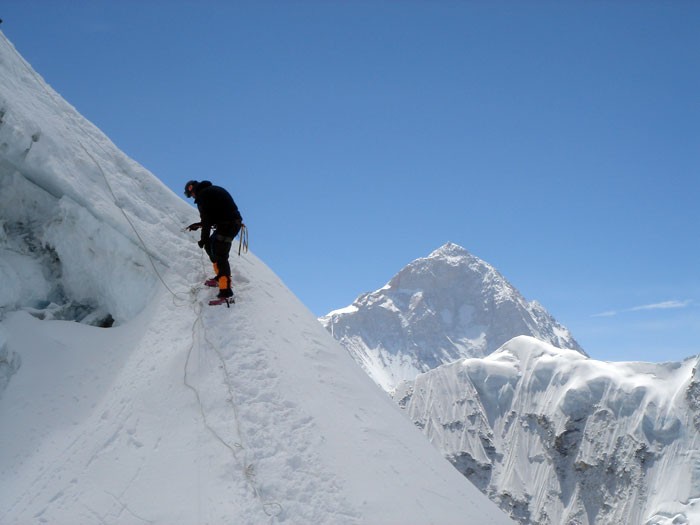
Island Peak is a renowned trekking peak located in the heart of Nepal. It was discovered in the 1950s by Sherpas and foreign mountaineers who were testing Everest oxygen equipment. This peak stands out on its own and is not attached to the Nuptse-Lhotse Face through any ridge which is why it was named Island Peak. The popular peak is only a few days' walk away from Namche Bazaar, the trading center for the Khumbu Sherpas. Although Island Peak stands at only 6189m / 20,300 feet high - making it one of Nepal's lowest trekking peaks - this low elevation makes it all the more accessible and thus more popular among travelers looking for shorter climbs close to Mount Everest Base Camp. In fact, Island Peak has become the most sought-after of all of Nepal's trekking peaks because adventurers can easily organize a one-day climb as an add-on to their Everest base camp trek.
Sherpas will carry your heavy pack during the climb, and you just need to carry your light bag.
Your climb leader will be a western guide so you don’t need to learn Nepali language. Friendly sherpas will also be there to help you during the climb.
Four nights at the Harati Hotel are included in your trek fee i.e. two nights at the beginning of your trek and two nights at the end. Most of our guests stay happily at the Harati Hotel, a clean, friendly, hot water hotel with good rooms, a nice lobby, and a delicious breakfast located in the Kathmandu tourist district known as Thamel.
We provide three hot meals per day with lots of hot drinks. We do suggest you bring 1 kilo / 2 pounds of snacks like chocolate, chips, nuts, and you can easily and inexpensively buy these in Kathmandu.

Island Peak Expedition Experience and Training

Extensive experience is not required for climbing Island Peak. The most important thing is for members to be in adequate walking fitness. You may attempt this climb as a novice and we will teach you what you need to know.

Prior to joining our group, please see your doctor and obtain the necessary permission and advice, as well as medications for travel in extremes of altitude, and also for exotic locales.

Island Peak FAQs
The Island Peak climb can be done at nearly any time of year, but we offer our organized trips to Island Peak three times a year: April, November, and January. April is a very nice time to climb as it is generally dry and sunny with a few occasional weather events, but nothing serious. November is superb, with sunny days and cool clear nights. January is amazing. No one is on the mountain in January and you will have the place to yourself. While April and November are similarly warm, January will be cooler so please dress appropriately for January. 
Please bring $700 cash with you for Island Peak climb.
Permit cost - Spring and Autumn are $250 per person and winter is $125 per person.
Nepalese Visas are offered on arrival at Kathmandu International Airport. It is not necessary to pre-arrange, just show up at the Kathmandu Airport and pay $100
It takes total 22 Days in Nepal to climb Island Peak.
Island Peak is a very basic climb. It is for any person who desires of easy mountaineering adventure.
For Island Peak you need warm trekking clothing (trousers/shirts/underwear/socks), waterproof/windproof outer layers, a very warm thick down jacket with a hood, warm extra layers for your legs, thick warm mitts, medium-weight gloves, warm hats, and sun hats, headlamps with extra batteries, good sunglasses/goggles for snow.
An ice axe, helmet, harness, 2 locking carabiners, 4 standard carabiners, 4 slings, an ascender, a figure 8 descender, a 50-liter rucksack, three one-liter water bottles, a good sleeping bag and you will purchase your sleeping matts in Lukla.
If you brought everything you needed from home, that is fine. However, you can rent everything you need in Kathmandu and many of our Island Peak members rent or buy their clothing, shoes, and equipment in the more than 100 Kathmandu mountaineering and trekking shops, where there is a massive selection of new and second-hand items at good prices.
Island Peak is a renowned trekking peak located in the heart of Nepal. It was discovered in the 1950s by Sherpas and foreign mountaineers who were testing Everest oxygen equipment. This peak stands out on its own, and is not attached to the Nuptse - Lhotse Face through any ridge which is why it was named Island Peak. The popular peak is only a few days' walk away from Namche Bazaar, the trading center for the Khumbu Sherpas. Although Island Peak stands at only 6189m / 20,300 feet high, it is one of Nepal's lowest trekking peaks. This low elevation makes it all the more accessible and thus more popular among travelers looking for shorter climbs close to Mount Everest Base Camp. In fact, Island Peak has become the most sought-after of all of Nepal's trekking peaks because adventurers can easily organize a one-day climb as an add-on to their Everest Base Camp Trek.
You need good mountaineering snow boots with crampons, and good sturdy ankle high leather trekking shoes.
  • Fly to Lukla, trek up to Everest base camp for acclimatization, then on the way back down, side track to Island Peak and finally climb it, head back down to Lukla: 22 days.
  • Fly to Lukla, trek straight up to Island Peak and climb it, then trek straight back to Lukla, without visiting Everest Base Camp: 17 days.
  • Climb Island Peak as an “optional add-on” to another trek or climb, such as Ama Dablam, or Lobuche Peak: 5 days
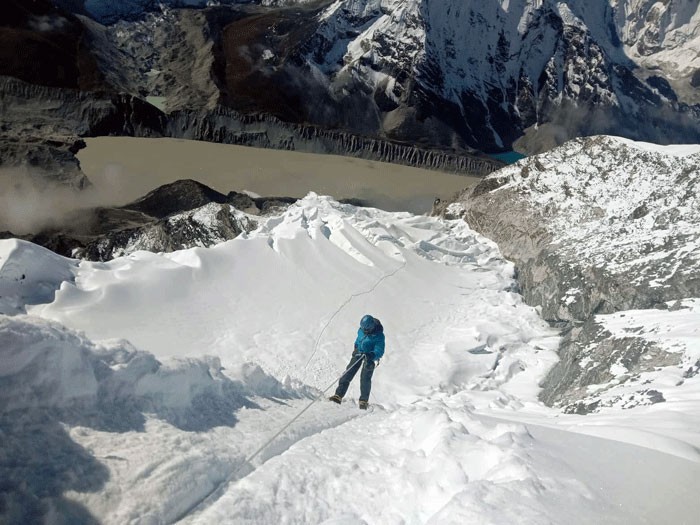
Island Peak is a renowned trekking peak located in the heart of Nepal. It was discovered in the 1950s by Sherpas and foreign mountaineers who were testing Everest oxygen equipment. This peak stands out on its own and is not attached to the Nuptse-Lhotse Face through any ridge which is why it was named Island Peak. The popular peak is only a few days' walk away from Namche Bazaar, the trading center for the Khumbu Sherpas. Although Island Peak stands at only 6189m / 20,300 feet high - making it one of Nepal's lowest trekking peaks - this low elevation makes it all the more accessible and thus more popular among travelers looking for shorter climbs close to Mount Everest Base Camp. In fact, Island Peak has become the most sought-after of all of Nepal's trekking peaks because adventurers can easily organize a one-day climb as an add-on to their Everest base camp trek.
Sherpas will carry your heavy pack during the climb, and you just need to carry your light bag.
Your climb leader will be a western guide so you don’t need to learn Nepali language. Friendly sherpas will also be there to help you during the climb.
Four nights at the Harati Hotel are included in your trek fee i.e. two nights at the beginning of your trek and two nights at the end. Most of our guests stay happily at the Harati Hotel, a clean, friendly, hot water hotel with good rooms, a nice lobby, and a delicious breakfast located in the Kathmandu tourist district known as Thamel.
We provide three hot meals per day with lots of hot drinks. We do suggest you bring 1 kilo / 2 pounds of snacks like chocolate, chips, nuts, and you can easily and inexpensively buy these in Kathmandu.

Island Peak Application Forms

Please fill out an application and return it to us with your refundable ten-percent deposit to hold your place on the team.


Island Peak Application for World Team Members (UK Office) :  PDF Form or MS Word Doc

Island Peak Application for US Team Members (US Office) PDF Form or MS Word Doc

In addition to your application, we will need the following at least two months before the Island Peak trip begins:

  • Completed Payment
  • Oxygen order (if any)
  • Sherpa order (if any)
  • Trip Registration form
  • 1 Passport sized photo
  • A scan of your passport identification pages
  • Complete flight itinerary
  • Proof of travel, accident, and repatriation insurance. We strongly recommend Global Rescue, with at least $50,000 worth of helicopter rescue insurance.
  • Trip cancellation/interruption insurance is recommended

Please contact us with any questions you may have.

Island Peak FAQs
The Island Peak climb can be done at nearly any time of year, but we offer our organized trips to Island Peak three times a year: April, November, and January. April is a very nice time to climb as it is generally dry and sunny with a few occasional weather events, but nothing serious. November is superb, with sunny days and cool clear nights. January is amazing. No one is on the mountain in January and you will have the place to yourself. While April and November are similarly warm, January will be cooler so please dress appropriately for January. 
Please bring $700 cash with you for Island Peak climb.
Permit cost - Spring and Autumn are $250 per person and winter is $125 per person.
Nepalese Visas are offered on arrival at Kathmandu International Airport. It is not necessary to pre-arrange, just show up at the Kathmandu Airport and pay $100
It takes total 22 Days in Nepal to climb Island Peak.
Island Peak is a very basic climb. It is for any person who desires of easy mountaineering adventure.
For Island Peak you need warm trekking clothing (trousers/shirts/underwear/socks), waterproof/windproof outer layers, a very warm thick down jacket with a hood, warm extra layers for your legs, thick warm mitts, medium-weight gloves, warm hats, and sun hats, headlamps with extra batteries, good sunglasses/goggles for snow.
An ice axe, helmet, harness, 2 locking carabiners, 4 standard carabiners, 4 slings, an ascender, a figure 8 descender, a 50-liter rucksack, three one-liter water bottles, a good sleeping bag and you will purchase your sleeping matts in Lukla.
If you brought everything you needed from home, that is fine. However, you can rent everything you need in Kathmandu and many of our Island Peak members rent or buy their clothing, shoes, and equipment in the more than 100 Kathmandu mountaineering and trekking shops, where there is a massive selection of new and second-hand items at good prices.
Island Peak is a renowned trekking peak located in the heart of Nepal. It was discovered in the 1950s by Sherpas and foreign mountaineers who were testing Everest oxygen equipment. This peak stands out on its own, and is not attached to the Nuptse - Lhotse Face through any ridge which is why it was named Island Peak. The popular peak is only a few days' walk away from Namche Bazaar, the trading center for the Khumbu Sherpas. Although Island Peak stands at only 6189m / 20,300 feet high, it is one of Nepal's lowest trekking peaks. This low elevation makes it all the more accessible and thus more popular among travelers looking for shorter climbs close to Mount Everest Base Camp. In fact, Island Peak has become the most sought-after of all of Nepal's trekking peaks because adventurers can easily organize a one-day climb as an add-on to their Everest Base Camp Trek.
You need good mountaineering snow boots with crampons, and good sturdy ankle high leather trekking shoes.
  • Fly to Lukla, trek up to Everest base camp for acclimatization, then on the way back down, side track to Island Peak and finally climb it, head back down to Lukla: 22 days.
  • Fly to Lukla, trek straight up to Island Peak and climb it, then trek straight back to Lukla, without visiting Everest Base Camp: 17 days.
  • Climb Island Peak as an “optional add-on” to another trek or climb, such as Ama Dablam, or Lobuche Peak: 5 days
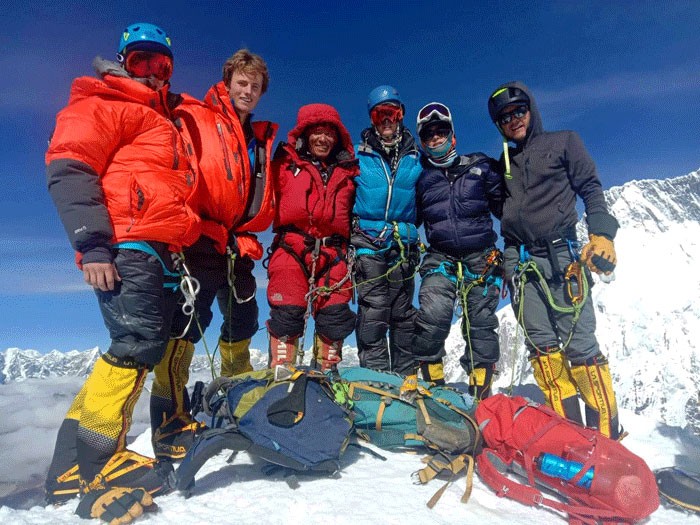
Island Peak is a renowned trekking peak located in the heart of Nepal. It was discovered in the 1950s by Sherpas and foreign mountaineers who were testing Everest oxygen equipment. This peak stands out on its own and is not attached to the Nuptse-Lhotse Face through any ridge which is why it was named Island Peak. The popular peak is only a few days' walk away from Namche Bazaar, the trading center for the Khumbu Sherpas. Although Island Peak stands at only 6189m / 20,300 feet high - making it one of Nepal's lowest trekking peaks - this low elevation makes it all the more accessible and thus more popular among travelers looking for shorter climbs close to Mount Everest Base Camp. In fact, Island Peak has become the most sought-after of all of Nepal's trekking peaks because adventurers can easily organize a one-day climb as an add-on to their Everest base camp trek.
Sherpas will carry your heavy pack during the climb, and you just need to carry your light bag.
Your climb leader will be a western guide so you don’t need to learn Nepali language. Friendly sherpas will also be there to help you during the climb.
Four nights at the Harati Hotel are included in your trek fee i.e. two nights at the beginning of your trek and two nights at the end. Most of our guests stay happily at the Harati Hotel, a clean, friendly, hot water hotel with good rooms, a nice lobby, and a delicious breakfast located in the Kathmandu tourist district known as Thamel.
We provide three hot meals per day with lots of hot drinks. We do suggest you bring 1 kilo / 2 pounds of snacks like chocolate, chips, nuts, and you can easily and inexpensively buy these in Kathmandu.